Key points
- Lawyers for the church told Supreme Court justice Michael McDonald on Thursday that legislation passed to make the church liable for abuse claims did not apply to the father of an alleged victim.
- The father’s barrister Julian Burnside, QC, argued that if the court found the legislation did not apply to family members impacted by the byproducts of sexual abuse it would undermine the purpose of the law.
- One of the choirboys allegedly abused by George Pell died in his 30s in 2014 from an accidental heroin overdose, having never made a complaint. The deceased man’s father, referred to in court under the pseudonym RWQ, has lodged a civil case in the Supreme Court.
Lawyers acting for the Catholic Church have argued that legislation passed to close a legal loophole that helped the church avoid liability for sex abuse victims does not apply to the father of a former choirboy whom prosecutors had alleged was sexually abused by George Pell.
But Julian Burnside, QC, acting for the father, told Supreme Court Justice Michael McDonald on Thursday that if the court found the legislation did not apply to family members, it would undermine the purpose of the law.
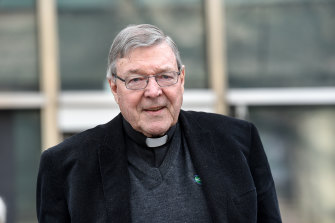
Cardinal George Pell in 2018.Credit:Just McManus.
Pell was in 2018 found guilty by a County Court jury of abusing two teenage choirboys in Melbourne’s St Patrick’s Cathedral after a Sunday Mass in December 1996. Those convictions were quashed by the High Court in 2020 and Pell was released from prison after more than a year in custody.
One of the choirboys died in his 30s in 2014 from an accidental heroin overdose, having never made a complaint against Pell. The deceased man’s father, referred to in court under the pseudonym RWQ, lodged a civil case in the Supreme Court last month.
Chris Caleo, QC, acting for the Archdiocese of Melbourne, said the Legal Identity of Defendants Act passed in 2018 made the church liable for financial compensation for damage inflicted on victims only, because it was designed to apply to survivors of abuse and not their families.
“We say that that context, as a whole, means that we are only talking about claims by the victim himself or herself,” Caleo said.
But Burnside argued against that assertion, saying the church’s submission was “plainly wrong” and not what parliament had intended when the legislation was passed. He said that such an interpretation could extinguish legal entitlements of families if a victim of child abuse dies, as in this case.
“The purpose of this statute was to make it possible to sue [non-governmental organisations],” he told Justice McDonald.
“What [the church’s] submission amounts to is … if the victim of child abuse dies, their family has no remedy, they have no one they can sue. That’s plainly wrong, in our submission.”
The so-called Ellis defence – a legal loophole Pell backed as Australia’s most senior Catholic to avoid paying large compensation sums to victims of clerical abuse – may prevail if the court finds the legislation doesn’t apply.
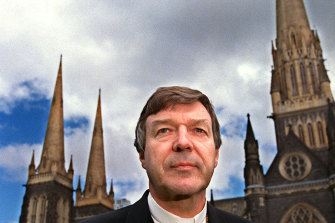
Pell in 1996, when he was archbishop of Melbourne.Credit:Craig Abraham
Legal sources say the defence could still be applied in some circumstances, including where the claimant is not the victim, but a family member.
The deceased choirboy’s father told The Age in 2019 that his son became withdrawn as a teenager, had problems at school and began using drugs. As an adult, he did stints in jail.
RWQ now claims he suffered psychological harm, including anxiety, a depressed mood and a bereavement disorder since his son’s death. He claims he has endured injury, loss and damage, which include past and future medical costs.
The Ellis defence was named after John Ellis, a former altar boy abused by a priest. His case for compensation failed when the church successfully argued in a NSW court that it could not be sued as it did not exist in a legal sense because property assets were held in a trust immune to lawsuits.
While serving as archbishop of Sydney, Pell backed the use of the legal strategy when the church defended civil claims made by abuse victims. It is estimated the strategy saved the church paying out many millions of dollars to abuse survivors.
With Adam Cooper
The Morning Edition newsletter is our guide to the day’s most important and interesting stories, analysis and insights. Sign up here.
Most Viewed in National
From our partners
Source: Read Full Article