Moscow: French President Emmanuel Macron – the highest-profile Western leader to visit Moscow since Russia began massing troops on the border with Ukraine – told Vladimir Putin at the Kremlin on Monday (local time) that there was a need to avoid war and build trust.
Macron told the Russian President he was seeking a “useful” response “that of course allows us to avoid war and to build bricks of trust, stability, visibility”.
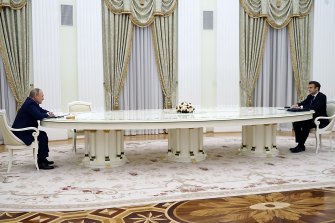
Russian President Vladimir Putin and French President Emmanuel Macron meet at the Kremlin.Credit:Kremlin via AP
Putin, for his part, said Russia and France shared “a common concern about what is happening in the security sphere in Europe”.
“I see how much efforts the current leadership of France and the President personally, is applying in order to solve the crisis related to providing equal security in Europe for a serious historical perspective,” Putin said.
Macron, who is expected to seek re-election in April, has positioned himself as a potential mediator, with French officials voicing scepticism over predictions by Washington, London and other Western capitals that a Russian assault is imminent.

Journalists watch as French President Emmanuel Macron speaks with Russian President Vladimir Putin at the Kremlin.Credit:AP
“The geopolitical objective of Russia today is clearly not Ukraine, but to clarify the rules of cohabitation with NATO and the EU,” Macron told the Journal du Dimanche newspaper on the eve of his trip to Russia.
On his arrival, Macron told reporters: “I’m reasonably optimistic, but I don’t believe in miracles.”
Kremlin spokesperson Dmitry Peskov said ahead of the talks: “The situation is too complex to expect decisive breakthroughs in the course of one meeting.”
Russia has deployed more than 100,000 troops near Ukraine’s borders. It denies planning an invasion, but says it is ready to take unspecified “military measures” if its demands to the West are not met, including a promise by NATO never to admit Ukraine and to withdraw some troops from Eastern Europe.
Washington has rejected those demands as non-starters, but says it is willing to talk about arms control and confidence-building steps, which Moscow has dismissed.
“In recent days there has been nothing new on the topic of security guarantees for Russia. Our Western interlocutors prefer not to mention this topic,” Peskov said.
The United States and its allies say they would respond to any invasion with sanctions, arms shipments and reinforcement of NATO countries nearby.
Last week Biden ordered nearly 3000 US troops to deploy in Poland and Romania to better protect NATO’s eastern flank. A US general arrived in Poland on Saturday and the bulk of the new forces due there were expected to arrive on Monday.
Germany, meanwhile, announced it would deploy 350 troops to Lithuania to reinforce a NATO battle group there.
Defensive alliance
In London, a spokesman for British Prime Minister Boris Johnson said Russian concerns about potential NATO aggression were “fundamentally unfounded as NATO is a defensive alliance at its heart”. He said Britain wanted to work with Moscow to provide it with reassurance on that point.
Russia sees NATO’s addition of 14 new Eastern European members since the Cold War ended three decades ago as an encroachment on its sphere of influence and a threat to its security.
German Foreign Minister Annalena Baerbock promised unequivocal support for Ukraine on Monday as she headed to Kyiv for her second trip in three weeks.
Germany said last month it would send 5000 military helmets to Ukraine – an offer derided by Kyiv’s mayor as “a joke” as Ukraine seeks weapons to defend itself.
Germany has ruled out sending lethal weapons for historical reasons arising from its role in the world wars of the 20th century, but Ukrainian Foreign Minister Dmytro Kuleba said he would raise the issue again with Baerbock.
“Germany has repeatedly and publicly explained this decision. We consider these explanations regarding Ukraine to be unfair. We believe that there is a wider space for Germany to act,” he said.
Chancellor Olaf Scholz, who took office last year after 16 years of leadership by Angela Merkel, was due to meet Biden at the White House on Monday and will visit Kyiv next week.
Reuters
Get a note directly from our foreign correspondents on what’s making headlines around the world. Sign up for the weekly What in the World newsletter here.
Most Viewed in World
From our partners
Source: Read Full Article