Is this Australia’s greatest miscarriage of justice? How mother wrongly jailed for killing her four babies was pardoned after DNA tests showed they could have died from a rare gene mutation – as she hails a ‘victory for science and truth’
- Kathleen Folbigg, 55, was released in June after spending 20 years in prison
- Her four babies died in suspicious circumstances between 1989 and 1999
The recording of the phone call to the emergency services makes for harrowing listening even 20 years after it was heard by jurors during an Australian murder trial.
It begins with the anguished cries of 33-year-old housewife Kathleen Folbigg, then living in the small New South Wales town of Singleton, about 125 miles north of Sydney.
‘I need an ambulance,’ she sobbed. ‘My baby’s not breathing. I’m not getting a heartbeat or anything.’
When the operator asked what might be wrong with her child, she said that she had already lost three babies to cot-death. Now it seemed that her 19-month-old daughter Laura had suffered a similar fate.
Only six months previously, the family had held a big party to celebrate the first birthday of the little girl, described by one relative as ‘a beautiful little kid’.

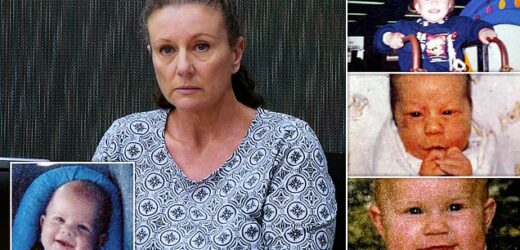
Kathleen Folbigg, 55, (pictured) was convicted of three counts of murder and one of manslaughter in 2003 after her babies Patrick, Sarah, Laura and Caleb died in suspicious circumstances between 1989 and 1999


Ms Folbigg was convicted of the murder of her two daughters Sarah (left) and Laura (right). Laura was the only sibling to have survived beyond the age of 10 months


Patrick Folbigg and his brother Caleb are pictured. Their mother Ms Folbigg was cleared of killing them
‘She was more than just a baby, she was a person and she was adored by everyone,’ he said.
The occasion was all the more special because Laura was the only one of her siblings to have survived beyond the age of 10 months. But she would never reach her second birthday. Although medics were quickly on the scene on that morning of March 1, 1999, she was pronounced dead on arrival at hospital.
Friends and neighbours were hugely sympathetic to a family who had suffered such an unimaginable catalogue of misfortunes but there was also suspicion — not least on the part of Kathleen’s husband Craig, a car salesman six years her senior.
He was instrumental in bringing about Kathleen’s subsequent conviction for smothering all four of her offspring, her motivation supposedly being a low tolerance of stress which made her resent the demands they made of her.
READ MORE: Why Kathleen Folbigg was suddenly pardoned after spending 20 years in prison – as ‘new evidence came to light’
Sentenced to 40 years in prison, Kathleen was dubbed ‘Australia’s worst female serial killer’ and ‘most hated woman’.
For many years she was imprisoned in Silverwater, the country’s toughest women’s prison. Inmates there included cannibal Katherine Knight who skinned her partner and boiled his body parts for dinner.
After being transferred to another jail in northern New South Wales, she was brutally assaulted by a prisoner who left her with a black eye and bruises, and friends became increasingly fearful for the life of the woman targeted for being a ‘baby killer’.
Somehow managing to survive all that was thrown at her, she maintained her innocence throughout and this month, in a remarkable turn of events, she was pardoned and released from prison.
Apparently one of Australia’s greatest miscarriages of justice, her case has been compared to that of Lindy Chamberlain, wrongly convicted of murdering her baby daughter after she was snatched by a dingo during a family camping trip in 1980.
‘Kathleen has not only lost one child, she’s lost four,’ said her solicitor Rhanee Rego on her release. ‘She’s been in jail for 20 years, the system has failed her at every step. Instead of trying to understand why her children died, we threw her in jail. It’s unimaginable.’
It certainly is and yet Kathleen Folbigg’s wrongful imprisonment is but one of many cruel twists in a life haunted by trauma.
Born in 1967, she was just 18 months old when her British father murdered her mother, stabbing her 24 times in a Sydney street before he was deported after 15 years in jail.

Kathleen was dubbed ‘Australia’s worst female serial killer’ and ‘most hated woman’ following the deaths of her babies
Raised by foster parents in a working-class suburb of Newcastle, two hours drive north of Sydney, she left school at 15 and she was working as a waitress when she met Craig two years later. They were married within three years, and Kathleen couldn’t wait to start a family in the small house they bought in Newcastle.
‘I just thought that was what I was on the planet for,’ she said in a 2018 TV interview given over the phone while she was still in prison.
‘To meet a fella, get married, have a child, do the family. I guess because of being a foster kid, I thought family was the ultimate important thing.’
Their first child Caleb was born on February 1, 1989, a fit and healthy baby whose arrival was a happy time for them both, says journalist Matthew Benns in his book When The Bough Breaks.
READ MORE: Kathleen Folbigg breaks her silence after being released from prison: ‘Today is a victory for science, and especially truth’
‘They revelled in their role as the new parents of a gorgeous little baby, doing what all other new parents do, observing whose nose their baby had, whose fingers and so on.’
On the evening of February 20, when Caleb was only 19 days old, Kathleen put him down in his bedroom, wrapped in a white baby blanket. The last time she saw him alive was when she got up in the night to feed him. By the time she checked him again, he was limp and lifeless.
His death was officially recorded as Sudden Infant Death Syndrome (SIDS), commonly known as cot death. Advised that it seldom happened twice within one family, they tried for another baby and their second son Patrick arrived in June the following year.
Like his brother before him, he was perfectly healthy but one night that October, Kathleen popped in on him and discovered that he was having problems breathing.
Although they called an ambulance and he was revived, he suffered severe brain damage which led to him having seizures. Four months later, Kathleen put him to bed one morning only to discover later that he had stopped breathing in his sleep.
The death certificate stated that he had died from suffocation caused by an epileptic fit. And once again, Craig and Kathleen were left to redecorate his room, pack away the toys they had bought him, and try to deal with this latest blow.
To escape the memories of all that had happened, they moved to a new house further from Newcastle but there were tensions over whether they should have another child.
While Craig could not face the thought of losing another baby, Kathleen saw it as a way of moving on with their lives and their daughter Sarah was born on October 14, 1992.

Born in 1967, Ms Folbigg was just 18 months old when her British father murdered her mother, stabbing her 24 times in a Sydney street before he was deported after 15 years in jail
Another healthy baby, she survived her early months to become what Kathleen described as ‘the cheekiest one ever, running around sticking her tongue out at you if she thought that was going to get a laugh’.
Yet again, the family’s happiness was short-lived. In August 1993, when Sarah was 10 months old, Craig was torn from his sleep by Kathleen’s screams. She had found Sarah lifeless in the single bed they had placed at the foot of their own bed. As with Caleb, her death was attributed to SIDS.
Sarah’s death led to more problems within the marriage as the couple struggled with their grief. They separated at one point and, although they got back together again and had baby Laura, who was born in August 1997, her death less than two years on finally saw them separate.
By then, they were living in Singleton and Kathleen moved out of the family home and into a rented flat. And while Craig was sorting out their belongings, he came across her personal diaries and was alarmed by what he read.
In one entry, penned shortly after Laura was born, Kathleen wrote: ‘One day [she] will leave. The others did but this one’s not going in the same fashion. This time I’m prepared and know what signals to watch out for in myself.’
In another, referring to Sarah, she wrote: ‘I knew I was short-tempered and cruel sometimes to her and she left with a bit of help. I don’t want that to ever happen again.’
After Craig showed the diaries to the police Kathleen was charged with the murders of her four children and was eventually brought to trial at the New South Wales Supreme Court in Sydney in April 2003.

Kathleen carries a rare mutation of a gene which is critical to regulating the heartbeat. If it’s not functioning, the heart can stop
There, her former husband was among those testifying against her and, although the evidence was entirely circumstantial, the jury was unanimous in finding her guilty of the manslaughter of Caleb and the murders of Patrick, Sarah and Laura.
In the years to come, doubts about her conviction grew in both medical and legal circles and an inquiry in 2019 was presented with evidence which challenged a central plank of the prosecution’s case — the unlikelihood of four infants within one family dying from natural causes.
That case was based on Meadow’s Law, a now widely discredited legal concept devised by Sir Roy Meadow, often seen as Britain’s pre-eminent paediatrician until a series of wrongful convictions that relied on his theory.
They included that of Sally Clark, a solicitor erroneously jailed for the murders of her two baby sons after Meadows told a court that the odds of a second cot death in a family were 73 million to one. In fact, the true figure was about 200 to one.
Although her conviction was quashed, her family said that she was never able to return to being ‘the happy, kind and generous person we all knew’ and she died of a suspected heart attack two years after her release.
Meadow’s Law holds that ‘one sudden infant death is a tragedy, two is suspicious and three is murder until proved otherwise’. Yet in Kathleen’s case it was undermined by the findings of Professor Carola Vinuesa, a genetics expert at the Francis Crick Institute in London.

While neither of the boys had this genetic mutation, several experts testified that Patrick may have died of a different genetic disorder which led to his seizures
She analysed samples of the family’s DNA using an internal cheek swab obtained from Kathleen in prison, along with frozen cells removed during the post-mortem examinations of Patrick and Sarah and routine blood samples taken from Caleb and Laura at birth.
These showed that Kathleen carries a rare mutation of a gene which is critical to regulating the heartbeat. If it’s not functioning, the heart can stop. And, crucially, Professor Vinuesa showed that both Sarah and Laura carried the same gene.
While neither of the boys had this genetic mutation, several experts testified that Patrick may have died of a different genetic disorder which led to his seizures. And if he, Laura and Sarah might all have died from natural causes then this also cast doubt over Caleb’s death.
Although this seemed a compelling argument, it was rejected by the 2019 inquiry, prompting 90 scientists around the world, including two Australian Nobel Laureates, to petition the governor of New South Wales to pardon Kathleen.
This led to a new inquiry earlier this year, chaired by retired judge Tom Bathurst who also considered concerns about how the diary evidence had been used during the trial. There was no attempt to search for an alternate interpretation of the handful of words, or to understand the context in which they had been written.
‘Evidence suggests they were the writings of a grieving and possibly depressed mother, blaming herself for the death of each child, as distinct from admissions that she murdered or otherwise harmed them,’ Tom Bathurst decided.
His finding that there was ‘reasonable doubt’ of a conviction led to her being pardoned — a decision slammed by her ex-husband Craig who remarried in 2004.
‘Craig has no doubt that his children were murdered,’ his lawyer Danny Eid has commented, describing his client as ‘frustrated and disappointed’ by the news.
As for Kathleen, the closest she has given to an interview since her release is a brief online video in which she spoke of it as ‘a victory for science and especially truth’.
Since her release, she has been staying with her childhood friend and long-time supporter Tracy Chapman at her farm in Coffs Harbour, some 270 miles north of Singleton.
There, according to Tracy, she has been ‘grateful to sleep in a good bed’ and has marvelled at the number of TV channels available today.
Fortunately, that is not the only change that society has seen during her time in prison, the tragedy being that the scientific advances which finally secured her freedom came 20 years too late.
Source: Read Full Article