Ukrainian President Zelensky will address MPs tomorrow as Speaker grants request for unprecedented speech via video link
- Volodymyr Zelensky will give a ‘historic address’ to MPs on Tuesday by video link
- Sir Lindsay Hoyle said he would allow for Mr Zelensky to read a statement
- He said: ‘Every parliamentarian wants to hear directly from the president’
Ukrainian President Volodymyr Zelensky will give a ‘historic address’ to MPs on Tuesday via video link tomorrow.
Commons Speaker Sir Lindsay Hoyle said he granted the request for Mr Zelensky to read a statement to the House of Commons at 5pm on Tuesday on the Russian invasion of his country.
Sir Lindsay said: ‘Every parliamentarian wants to hear directly from the president, who will be speaking to us live from Ukraine, so this is an important opportunity for the House.

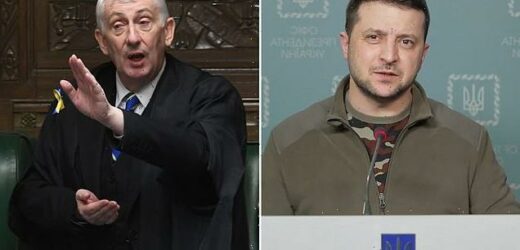
Ukrainian President Volodymyr Zelensky (pictured) will give a ‘historic address’ to MPs on Tuesday by video link, it has been announced

Commons Speaker Sir Lindsay Hoyle (pictured) said he had granted the request for Mr Zelensky to read a statement to the House of Commons at 5pm on Tuesday on the Russian invasion of his country
‘Thanks again to our incredible staff for working at pace to make this historic address possible.’
MPs will be able to watch the speech on screens installed overnight above either side of the chamber, House of Commons officials said.
More than 500 headsets will be made available to enable the UK’s elected representatives to hear a simultaneous translation in English.
There will be no questions at the end of the address to Mr Zelensky, who is reportedly at risk of assassination by pro-Russian groups in Kyiv.
Reports have suggested the Ukrainian leader will call for more arms to help defend his country and renew demands for a no-fly zone to stem the Russian attack.

Hundreds of civilians have today been fleeing the city of Irpin, to the west of Kyiv, after it came under heavy attack by Russian forces in recent days while Putin’s men try to encircle the capital

Elderly people and families with children are helped across a fast-flowing river underneath a destroyed road bridge outside Irpin, a city to the west of Kyiv, which Russian forces have been attacking

People rush to the train as an officer takes children and women first at the central train station in Odessa on March 7
The UK and Nato allies have consistently ruled out policing Ukraine’s skies, with concerns it could escalate and broaden the conflict, with Vladimir Putin also declaring that any third party involvement in a no-fly zone would be read as active participation in the battle.
During diplomatic meetings on Monday, Boris Johnson agreed with allies that more defensive support needs to be given to Ukraine.
The Prime Minister met his Dutch counterpart Mark Rutte at Downing Street, with No 10 saying they agreed to ‘continue to support Ukraine economically, diplomatically and with defensive equipment’.
In later discussions with US President Joe Biden, French President Emmanuel Macron and German Chancellor Olaf Scholz, Mr Johnson stressed that the ‘goal must be ensuring Putin’s failure in this act of aggression’, with the allies agreeing to continue to ‘isolate’ Mr Putin, according to Downing Street.
Mr Zelensky addressed MEPs in the European Parliament last week and on Saturday gave a virtual message to the US Senate as his country’s defence against the incursion continues.
The confirmation of the president’s address comes as Western focus turns to what more can be done to weaken Russia’s economy in a bid to force Moscow to withdraw from the conflict.
Announcing a further £175 million of UK aid for Ukraine, Mr Johnson said Kyiv’s friends needed to create a ‘coalition’ of support – humanitarian and economic, as well as militarily – to ensure Mr Putin’s ‘brutal’ invasion fails.

Kyiv today rejected Russia’s offer of ‘humanitarian corridors’ to evacuate civilians after it emerged several of them led to Russian territory or its close ally Belarus (top). Red Cross workers in Mariupol also said one of the routes Russia identified for civilians to leave the city had been covered with land mines

A father breaks down in tears as he says goodbye to his family in front of an evacuation train at the central train station in Odessa

A child cries as she waves at her mother as people board a bus in Odessa in an effort to flee Russia’s invasion

People wait to get into a train at the central train station in Odessa amid Russia’s invasion of the country
‘The president of Russia is plainly doubling down,’ he told a press conference in Downing Street.
‘He has decided that he is going to continue with an all-out onslaught on centres of habitation in a way that we think is utterly repugnant. It’s clear that we’re going to have to do more.’
To tighten the squeeze on the Kremlin’s war chest, Mr Johnson warned that European countries would need to secure substitute sources of energy supply if they are to ban Russian oil and gas imports.
US Secretary of State Antony Blinken said over the weekend that Washington was in ‘very active discussions’ with European allies over energy sanctions amid calls from Mr Zelensky for tougher action.
His comments saw gas prices surge by more than 70% to a new all-time high, while the cost of oil reached its highest level for 14 years.
But following talks in Downing Street with Mr Rutte and Canada prime minister Justin Trudeau, the British leader called for a ‘step-by-step’ approach as European countries weaned themselves off Russian hydrocarbons.
In the UK, he said ministers were looking at the possibility of using more oil and gas from British sources – although he insisted this did not mean abandoning its commitment to reducing carbon emissions.
‘It is completely the right thing to do to move away from dependence on Russian hydrocarbons, but we have to do it step by step,’ Mr Johnson told a joint news conference.
‘We have got to make sure we have substitute supply. One of the things we are looking at is the possibility of using more of our own hydrocarbons.

A couple embrace each other as they stand in front of an evacuation train at the central train station in Odessa

Hundreds of people queue for trains to Poland following the Russian invasion of Ukraine, in Lviv, Ukraine

A woman in a wheelchair is assisted by local residents as she is evacuated from Irpin

Ukrainian soldiers help an elderly woman to cross a destroyed bridge as she evacuates the city of Irpin,

Residents of Irpin flee heavy fighting via a destroyed bridge as Russian forces entered the city in Irpin

Residents cross the destroyed bridge as they flee from the frontline town of Irpin, Kyiv region in Ukraine following Russia’s invasion

A woman is assisted by a member of the Ukrainian military as she flees heavy fighting in Irpin via a destroyed bridge as Russian forces entered the city today

Civilians continue to flee from Irpin due to ongoing Russian attacks in Irpin,

A woman carries her pet cat as evacuees cross a destroyed bridge as they flee the city of Irpin, northwest of Kyiv
‘That doesn’t mean we are in any way abandoning our commitment to reducing CO2, but we have got to reflect the reality that there is a crunch on at the moment. We need to increase our self-reliance.’
Mr Rutte warned that if countries moved too quickly to ban Russian oil and gas, it could backfire with ‘enormous consequences’, arguing that the West should be wary of generating ‘unmanageable risks to energy supply’, including within Ukraine.
Meanwhile, ministers were pushing a new Economic Crime Bill through the Commons on Monday in a fast-track procedure to bolster its ability to target oligarchs.
The Government has faced criticism for refusing to open its borders to Ukrainians, but Mr Johnson insisted during a press briefing on Monday that the UK would welcome those fleeing the fighting, with thousands of visa applications being processed.
The Home Office revealed that only ‘around 50’ visas had been granted under the Ukraine Family Scheme as of 10am on Sunday, but Mr Johnson said that ‘thousands’ of applications were being processed.
The Daily Mail, Mail On Sunday and MailOnline UKRAINE REFUGEE APPEAL
Readers of Mail Newspapers and MailOnline have always shown immense generosity at times of crisis.
Calling upon that human spirit, we are now launching an appeal to raise money for refugees from Ukraine.
For, surely, no one can fail to be moved by the heartbreaking images and stories of families – mostly women, children, the infirm and elderly – fleeing from Russia’s invading armed forces.
As this tally of misery increases over the coming days and months, these innocent victims of a tyrant will require accommodation, schools and medical support.
All donations to the Mail Ukraine Appeal will be distributed to charities and aid organisations providing such essential services.
In the name of charity and compassion, we urge all our readers to give swiftly and generously.
TO MAKE A DONATION ONLINE
Donate at www.mailforcecharity.co.uk/donate
To add Gift Aid to a donation – even one already made – complete an online form found here: mymail.co.uk/ukraine
Via bank transfer, please use these details:
Account name: Mail Force Charity
Account number: 48867365
Sort code: 60-00-01
TO MAKE A DONATION VIA CHEQUE
Make your cheque payable to ‘Mail Force’ and post it to: Mail Newspapers Ukraine Appeal, GFM, 42 Phoenix Court, Hawkins Road, Colchester, Essex CO2 8JY
TO MAKE A DONATION FROM THE US
US readers can donate to the appeal via a bank transfer to Associated Newspapers or by sending checks to dailymail.com HQ at 51 Astor Place (9th floor), New York, NY 10003
Source: Read Full Article