War veteran Ben Roberts-Smith directed another soldier to kill an Afghan detainee during a mission on Easter Sunday in 2009, a serving Special Air Service soldier has told the Federal Court.
Mr Roberts-Smith is suing The Age and The Sydney Morning Herald, owned by Nine, and The Canberra Times, now under separate ownership, for defamation over a series of reports in 2018 that he says portray him as a war criminal.
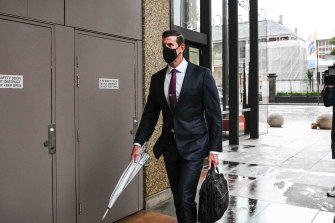
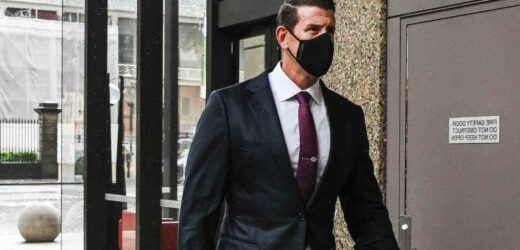
Ben Roberts-Smith arrives at the Federal Court in Sydney on Monday.Credit:Flavio Brancaleone
The defamation trial resumed in the Federal Court in Sydney on Monday after a six-month break with evidence from Person 41, a Special Air Service soldier who was deployed to Afghanistan in 2009 at the same time as Mr Roberts-Smith.
The media outlets are seeking to rely on a defence of truth and allege Mr Roberts-Smith committed or was involved in six murders of Afghan persons under the control (PUC) of Australian troops, who cannot be killed under the rules of engagement. The former SAS soldier denies all wrongdoing and maintains any killings in Afghanistan were carried out lawfully in the heat of battle.
Person 41, who was called to give evidence by the newspapers, told the court he was on a mission in Afghanistan on Easter Sunday in 2009, which involved clearing buildings in a compound dubbed Whiskey 108. A number of patrols were involved in that mission, including his own six-member patrol and a separate patrol of which Mr Roberts-Smith was a member.
Person 41 said he had discovered a room containing materials to make improvised explosive devices as well as a “black sticky substance” he later learned was opium. He told the court he heard “louder voices and talking and a bit of a commotion outside” and went to investigate.
He said Mr Roberts-Smith and a second soldier, Person 4, were in a courtyard.
“Just beyond them … was an Afghan male, squatting down,” he said. “An older male, dressed in traditional Afghan loose top and clothing … short, cropped hair.”
He said Person 4 and Mr Roberts-Smith approached him and asked to borrow the suppressor from his rifle.
“I thought it was a bit of a strange request at first, but I complied. I removed the suppressor from my M4 assault rifle and handed it to Person 4.”
Asked why he thought this was a strange request, Person 41 said: “I would have thought that Person 4 would have had his on him at the time. In my patrol at least … you had it on you at all times.”
He said Mr Roberts-Smith and Person 4 began to walk back towards the Afghan man squatting against a wall and he “thought to myself, ‘I think I know what’s about to happen here.’
“RS then walked down and grabbed the Afghan male by the scruff of the shirt, picked him up, marched him a couple of metres forward [until] he was in front of Person 4. He then kicked him in the back of the legs behind the knees until he was kneeling down in front of Person 4. He pointed to the [Afghan man] … and said to Person 4, ‘Shoot him.’”
Person 41 said he didn’t want to witness what was about to happen, and he stepped back into the room he had been inspecting.
“I heard a single suppressed shot which I knew was from an M4 rifle. I have fired thousands and thousands of rounds from an M4 with a suppressor on, and I know what it sounds like. I waited in that room for probably another 15 or so seconds.”
When he returned to the courtyard, there was a “dead Afghan male” at the feet of Person 4, he said. Person 4 returned the suppressor to him, he said, and it was still warm. “I knew it had just been used to shoot that Afghan.”
Mr Roberts-Smith gave evidence in June last year about the alleged events at Whiskey 108. He flatly rejected a suggestion that he had encouraged Person 4 to shoot the Afghan man by kneeling him in front of the soldier and saying “shoot him”.
The media outlets allege a third SAS soldier, Person 5, had already ordered the killing in Mr Roberts-Smith’s presence, an allegation Mr Roberts-Smith described last year as “completely false”.
The trial, which is slated to run for 10 weeks, had entered its fourth week last June when Sydney’s growing coronavirus outbreak led to the hearings being halted.
The trial resumed temporarily for a week in July to hear evidence from a group of Afghan villagers, who spoke via video link from Kabul, before it was adjourned.
The parties, witnesses and lawyers are appearing in person in court, but the courtroom is not open to the media or members of the public. There are arrangements in place for the hearings to be viewed online, in some cases after a delay.
Justice Anthony Besanko explained this morning that some of the witnesses who will be called in the trial are current or former Special Operations Command members, whose identities cannot be revealed owing to national security considerations.
Some of their evidence may also be heard in closed court sessions involving only the judge, the parties and their lawyers.
To guard against the inadvertent disclosure of national security information, the public will not have access to unrestricted livestreaming of the public parts of their evidence, but will be able to watch it later on the Federal Court’s YouTube channel.
“That recording will be made publicly available within 24 hours, or such further period as the court may allow,” Justice Besanko said.
“A limited number of representatives of recognised media organisations whose identities are known and who, by reason of their profession, owe professional and ethical obligations, will be given access to real time livestreaming, subject to appropriate undertakings.”
The hearing continues.
The Morning Edition newsletter is our guide to the day’s most important and interesting stories, analysis and insights. Sign up here.
Most Viewed in National
From our partners
Source: Read Full Article