STEPHEN GLOVER: The bumbling and inept Governor of the Bank should fall on his sword – and if he declines, Rishi should do it for him
For a quarter of a century it was generally accepted that Gordon Brown had been bold and far-sighted in giving the Bank of England operational independence over monetary policy in 1997.
Even the former Labour Chancellor’s critics have mostly agreed that, although he may have made his fair share of mistakes, he was right to remove self-serving politicians from the process of setting interest rates.
And, indeed, for many years Mr Brown’s revolution appeared to have been vindicated. Until recently, Britain enjoyed a long period of low inflation, although as other developed economies also did, the Bank can scarcely lay claim to unique competence.
But what happens if the Bank seriously fouls up? What can, and should, the Government do if the Governor of the Bank of England makes a series of mistakes for which he’s unwilling to accept responsibility?
This is the predicament in which we now find ourselves. Mr Brown’s much-lauded system no longer seems so perfect after all.

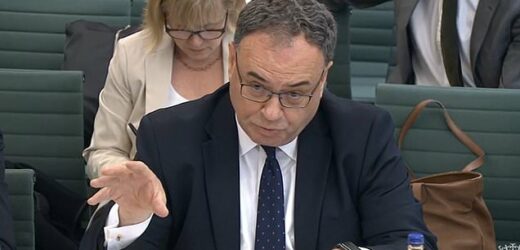
Andrew Bailey, the inept and bumbling Governor who has presided over a catalogue of errors, is theoretically secure in his £575,000-a-year job until 2028 (pictured May 23)

It was generally accepted that Gordon Brown had been bold and far-sighted in giving the Bank of England operational independence over monetary policy in 1997
Yet Andrew Bailey, the inept and bumbling Governor who has presided over a catalogue of errors, is theoretically secure in his £575,000-a-year job until 2028.
That the Bank has failed in its remit can’t be denied. Although Britain’s annual headline rate of inflation fell from 10.1 to 8.7 per cent in April, it is still the highest among the advanced G7 economies.
The price of food has risen faster in the UK than in almost any other advanced economy. Over 12 months, the cost of eggs has gone up by 37 per cent, of milk by 34 per cent and of flour by 30 per cent.
It seems certain that interest rates will rise from the current level of 4.5 per cent, possibly as far as 6 or even 7 per cent, according to some economists. That would mean cripplingly higher mortgage rates for millions, and possibly a crash in house prices.
Various reasons have been put forward to explain why inflation is stubbornly higher in this country than in many others.
Britain’s energy costs are greater, despite nearly half our gas coming from the North Sea, and our boast of being ‘world leaders’ in renewable energy. Others have blamed the tight labour market.
No doubt these factors have played a part. But there appears to be a near-consensus among economists — insofar as the practitioners of the ‘dismal science’ can ever agree on anything — that the Bank of England was deplorably slow in putting up interest rates last year, so that inflation was not brought under control.
As long ago as May 2021, the Bank’s former chief economist, Andrew Haldane, warned of the threat of rising inflation. The imperturbable Andrew Bailey was having none of it: increasing prices were transitory, and swift action wasn’t required. Meanwhile, the Bank’s forecasts have been regularly awry.

As long ago as May 2021, the Bank’s former chief economist, Andrew Haldane, warned of the threat of rising inflation
Mr Haldane may have been aware of the probable inflationary effect of the Bank’s post-Covid renewed splurge of quantitative easing, whereby £450 billion was pumped into the economy during 2020 and 2021.
When interest rates were eventually raised, the process was painfully gradual and the increases small. The Bank was consistently behind the curve. Of course, Mr Bailey wasn’t entirely responsible, but he set the laid-back tone.
Indeed, when it became clear that inflation was soaring out of control, he looked around for culprits other than himself. Workers were to blame for demanding excessive pay rises. Businesses were at fault for raising prices too eagerly, and older people for leaving the workforce.
Exhortation is practically futile in such circumstances. The one reality that businesses and workers will acknowledge is that of more expensive money through higher interest rates. The Bank should have turned the tap sooner.
And now — if we may leave Mr Bailey and the Bank of England for a moment — we see the ludicrous spectacle of the Government contemplating its own form of exhortation. It hopes to persuade supermarkets not to put up the price of some foods.
It would be astonishing if this sticking-plaster approach to economics were effective. Supermarkets aren’t going to impoverish themselves to please ministers. They may go along with the plan in order to look like goody-goodies, but they won’t undermine their own businesses, and nor should they be expected to.
What this risible episode reveals is that the Government has rather little in its locker when it comes to controlling inflation, and so takes refuge in idiotic notions such as asking capitalists to cut their profit margins.
Real power lies with a dysfunctional Bank of England, which could and should have brought inflation under control if it had acted earlier. It will probably now be forced to raise interest rates to a level at which they could precipitate a recession, and at the very least are bound to cause widespread pain.
The truth is that the Bank is an oligarchy — a small group of unelected and unaccountable people making momentous decisions in a way that they deem best for us. If things go well, as they generally have for nearly 25 years, no one is going to complain.
But when things go wrong — when the mistakes of the Bank actually serve to worsen an admittedly already dire situation — people are liable to ask whether the system introduced by Gordon Brown is so wonderful after all.

It is widely accepted that if a company does badly, its boss should walk the plank. The same is true of a political leader who steers his party towards electoral defeat (file image)
The Government would certainly be wise to ponder the issue. For if interest rates do go up to 6 or 7 per cent, and provoke a house-price crash, it won’t be Andrew Bailey and the Bank’s monetary policy committee (about whose members the public knows zilch) who’ll be blamed. It will be Rishi Sunak and the Tories.
For most economists and City folk it’s an article of faith that the Bank of England should continue to be seen as independent of government if it is going to retain the confidence of the markets.
That may well be true. But what about the trust of the people in what is supposedly a democracy? The British constitution isn’t set in stone. The Bank was nationalised in 1946. Twenty-five years ago, a flawed politician made it independent. If it fails at a time of crisis, as it has, its role should be reviewed.
Of one thing I am absolutely certain. It is widely accepted that if a company does badly, its boss should walk the plank. The same is true of a political leader who steers his party towards electoral defeat.
It is unimaginable, when inflation is finally brought under control, having caused more damage to people’s lives than was necessary, that Andrew Bailey should be allowed to remain as Governor of the Bank of England.
The idea that he might occupy the job for another five years is absurd. Even in our debased public service, those who fill enormously important positions must accept responsibility for the failures of the institutions that they serve.
Power in public life ultimately resides with the Prime Minister, and the elected ruling party. It would be preferable if this discredited Governor fell on his sword. If he declines to do so, Rishi Sunak will have to do the job for him.
Source: Read Full Article