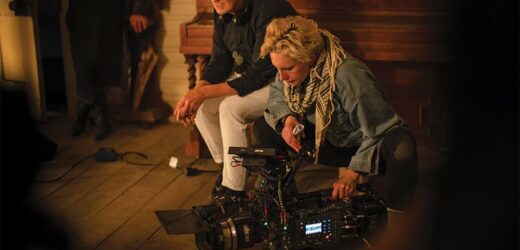
In 1997, UCLA cinematography professor William McDonald was home with his newborn daughter. As he looked into her eyes in his sleep-deprived state he began to wonder what her life would be like if she grew up and wanted to become a cinematographer. Would she have the same opportunities as men who wanted to study cinematography? Would she be able to find work after getting a degree and experience?
At the time, female cinematography students were few and far between. Things looked similarly bleak for working female DPs during that period. McDonald thought that could change if more women had the opportunity to study and train in the field, so he set a goal of admitting 50% female students into cinematography studies each year.
“The simple premise is that if you make a generational commitment — and about 25 to 30 years is a generational commitment — to flooding the market with exceedingly talented people from diverse backgrounds — in this case women — then you will make a change,” says McDonald. “The key thing is that if you flood the market, the dynamics will take care of themselves, because talent, passion and drive rise to the top.”
As we arrive in 2022 — about 25 years after McDonald made that generational commitment — there are undeniably gifted female cinematographers behind many of the year’s most lauded films. Ari Wegner’s work on “The Power of the Dog” has been nominated for an Oscar — only the second woman ever nominated for a cinematography Academy Award with Rachel Morrison being the first — and an ASC award. “Zola” also has Wegner to thank for its transcendent style.
Cinematographer Daria D’Antonio worked on “The Hand of God.” In “Spencer,” DP Claire Mathon created a unique way of shooting to capture Kristen Stewart’s most subtle expressions. Helene Louvart had dozens of credits before she became the DP on “The Lost Daughter,” helmed by Maggie Gyllenhaal. “In the Heights” was shot by Alice Brooks, who captured a riveting, energetic vision of New York. Brooks also worked on Lin-Manuel Miranda’s “Tick, Tick…Boom!” Denzel Washington brought Maryse Alberti on to film his “A Journal for Jordan.”
“It’s hard to know if things have changed dramatically or not in reality, but I think in recognition, definitely,” says Wegner, who notes her agent still receives emails inquiring about her availability for a project that assume she must be male. “I think the world suddenly became aware that there are a lot of women that are already doing this job and they’re not just doing little things here and there but actually shooting some of biggest movies. And that’s why it’s so important that we hear about what women are doing in cinematography for those that are the 13-year-olds and the 18-year-olds right now, and maybe people in their 20s or later that would be thinking about what they want to do.”
Mathon agrees: “Things are changing slowly, but yes, I think the industry is starting to accept and even desire women DPs on more and more ambitious and important films. I really hope that it will give other women the desire and ambition to become cinematographers. When I started working on ‘Portrait of a Lady on Fire,’ I really felt the need for role models. I’d be so glad if my work were to encourage young cinematographers to come.”
She is right to describe the change as gradually moving toward diversity. A recent study from the Center for the Study of Women in Television and Film at San Diego State University found that 6% of all cinematographers working on the top 250 films of 2021 were women. Over time this represents an increase of 2 percentage points from 4% in 1998. In 2020, the center found that just 3% of cinematographers working on the top 100 films were women.
With top female cinematographers earning more recognition for their work on some of the year’s most ambitious films, these numbers can make the overall picture seem murky. Susan Ruskin, dean at the AFI Conservatory and executive vice president at the American Film Institute, sees the beginning of a change as women rise through the ranks and take their places among working cinematographers. AFI has also made a commitment to admitting cinematography students of more diverse backgrounds, and holds a cinematography intensive program for women.
“In this year’s cohort, of which there are 25 students, we have 15 women, and this is actually the first year that there have been more females,” says Ruskin. “Now there are enough women that it no longer feels like ‘bro’ bonding. It feels like the bonding of the cinematography department, but it took a long time.”
Ruskin notes that the rise of more female directors has probably helped diversify cinematography as they make hiring decisions about their crew, and that will take consistent and conscious effort to make the changes stick. AFI is focused on mentorship as well and has five women on its cinematography faculty.
“Things have shifted, but it’s still hard to get into these fields without somebody who is willing to look at these moments not just as trying to lift somebody up, but also learning and growing as well,” says May Hong HaDuong, director of the UCLA Film & Television Archive. “So mentorship is not just a one-way street, and that’s something that’s important to consider.”
The ASC, which offers mentorship and educational opportunities, has its eye on welcoming new members from more diverse backgrounds, too. Through its vision committee, the society champions underrepresented cinematographers and their contributions to the craft. Amy Vincent, vice president of the ASC and co-chair of its future practices committee, has seen women take pivotal roles at the organization that she believes will make for a more inclusive and diverse environment.
“We’re now seeing that some of the people who graduated from programs have 10 years under their belt,” says Vincent. “I became very aware of it when I saw the list of the class of 2020 of the new members invited into the ASC, and the class of 2021. The number of women on that list is unparalleled. ASC membership is a legacy thing. It requires that a certain amount of work has already transpired. But we’re now at a place where we have increased our female members, we have women who are actively participating in committees, and most importantly, participating in the governance of the society, and that’s when we’ll see real change.”
Vincent, Ruskin and McDonald all agree that we’re witnessing the first stages of a turning point in which women will become more recognized for their work, and more women will take on significant roles in cinematography. At this point it’s not clear how much longer it may take to see larger numbers of women become recognized through awards season or become DPs on more films. They also all agree that this is not a phase or a temporary gain.
“It’s an unstoppable thing now,” says Vincent.
Source: Read Full Article

